
4. What If We Fed Collages Instead of Single Images?
This research introduces a creative and practically motivated idea aimed at addressing one of the most pressing challenges in few-shot learning at scale, which is the significant computational and memory overhead associated with storing and retrieving embeddings for large numbers of individual samples.
In a typical few-shot learning pipeline, once the model is trained to produce a well-structured embedding space, a database of embeddings is constructed by passing each sample through the model individually and storing the resulting vector representations.
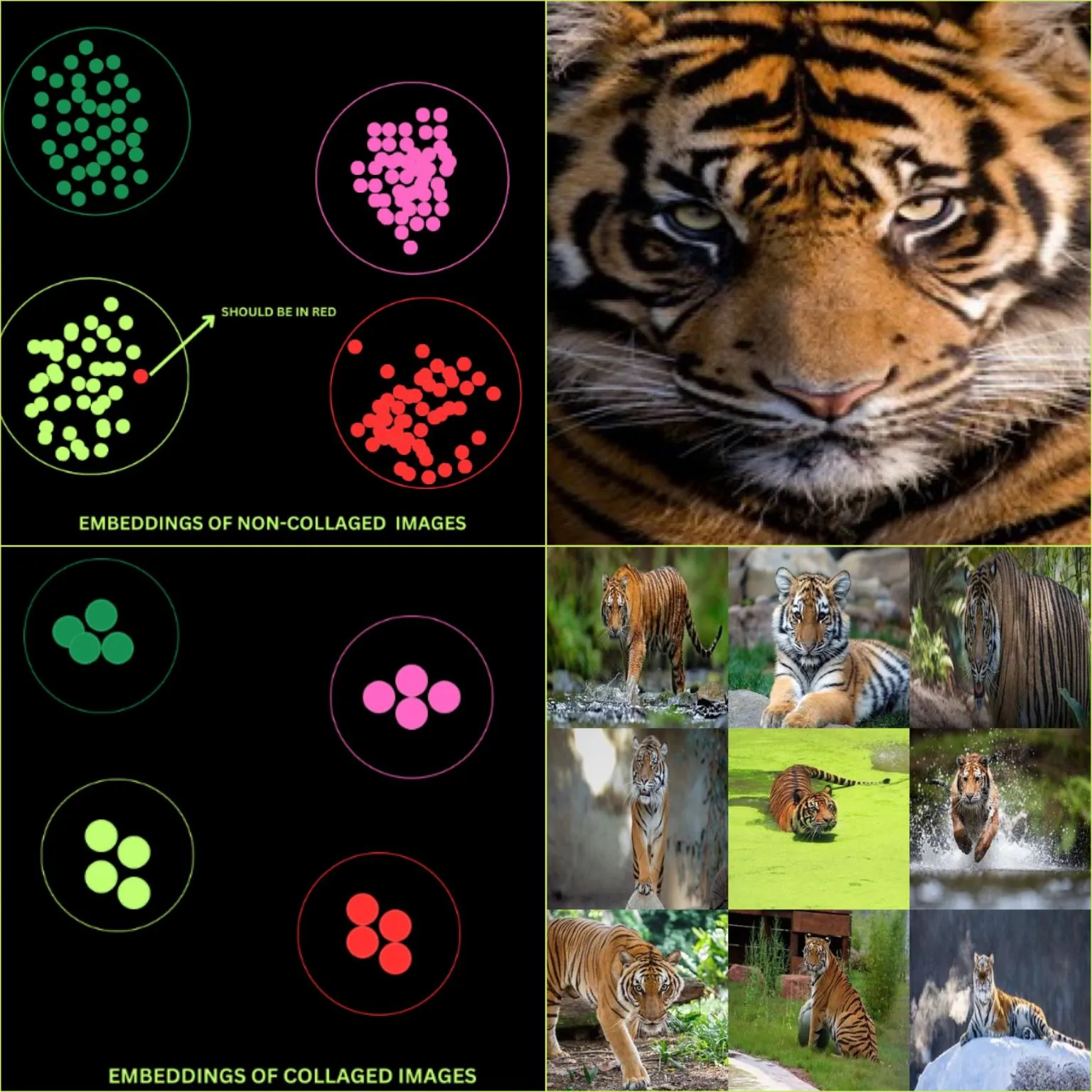
During inference, the embedding of a query sample is compared against this database to find the nearest neighbors and assign a class label. While this approach is conceptually elegant and often yields excellent accuracy, it becomes increasingly impractical as the dataset grows, since both the time required to extract embeddings and the memory needed to store them scale linearly with the number of samples.
The baseline experiment confirmed this concern, as with 1,621 individual samples, embedding extraction took 35 seconds and required 981 MB of storage, while achieving an accuracy of 99.01%.
The proposed solution is deceptively simple yet highly effective, in that instead of treating each sample as an individual input, multiple samples are arranged into a collage, in this case a 3x3 grid of nine images, and the entire collage is passed through the model as a single input to extract a single embedding that collectively represents all nine constituent images.
This approach dramatically reduces the number of embeddings that need to be stored, since one embedding now stands in for many individual samples.
The results were striking, as by switching to collaged embeddings, the total number of samples dropped from 1,621 to just 182, embedding extraction time fell from 35 seconds to just 3 seconds, and memory usage plummeted from 981 MB to just 105 MB, all while maintaining the exact same accuracy of 99.01%.
Beyond the efficiency gains, the collage approach also offers an additional benefit in terms of robustness, since a single embedding is derived from multiple images collectively, the influence of any individual outlier or misrepresentative sample is naturally diluted, reducing the likelihood of misclustering and making the overall embedding database more stable and reliable.
This research opens up a promising direction for scaling few-shot learning systems to real-world applications where computational resources are limited and datasets are large, suggesting that thoughtful preprocessing and representation strategies can yield significant efficiency improvements without sacrificing model performance.
Comments