
3. Can a Classifier Secretly Do FewShot's Job?
This research explores the reverse of the previous experiment's premise, and instead of examining how a few-shot model can fail like a classifier, it investigates how a standard classification model can, under the right conditions, exhibit behavior reminiscent of few-shot learning by forming meaningful and interpretable clusters for classes it has never been explicitly trained on.
The experiment was designed around a visually intuitive dataset consisting of images representing various shades of red, green, and blue, which are three broad color categories that the classifier was trained to distinguish. Once trained, the model was expected to have developed internal representations, or embeddings, that captured the underlying visual structure of these color families in a well-organized feature space.
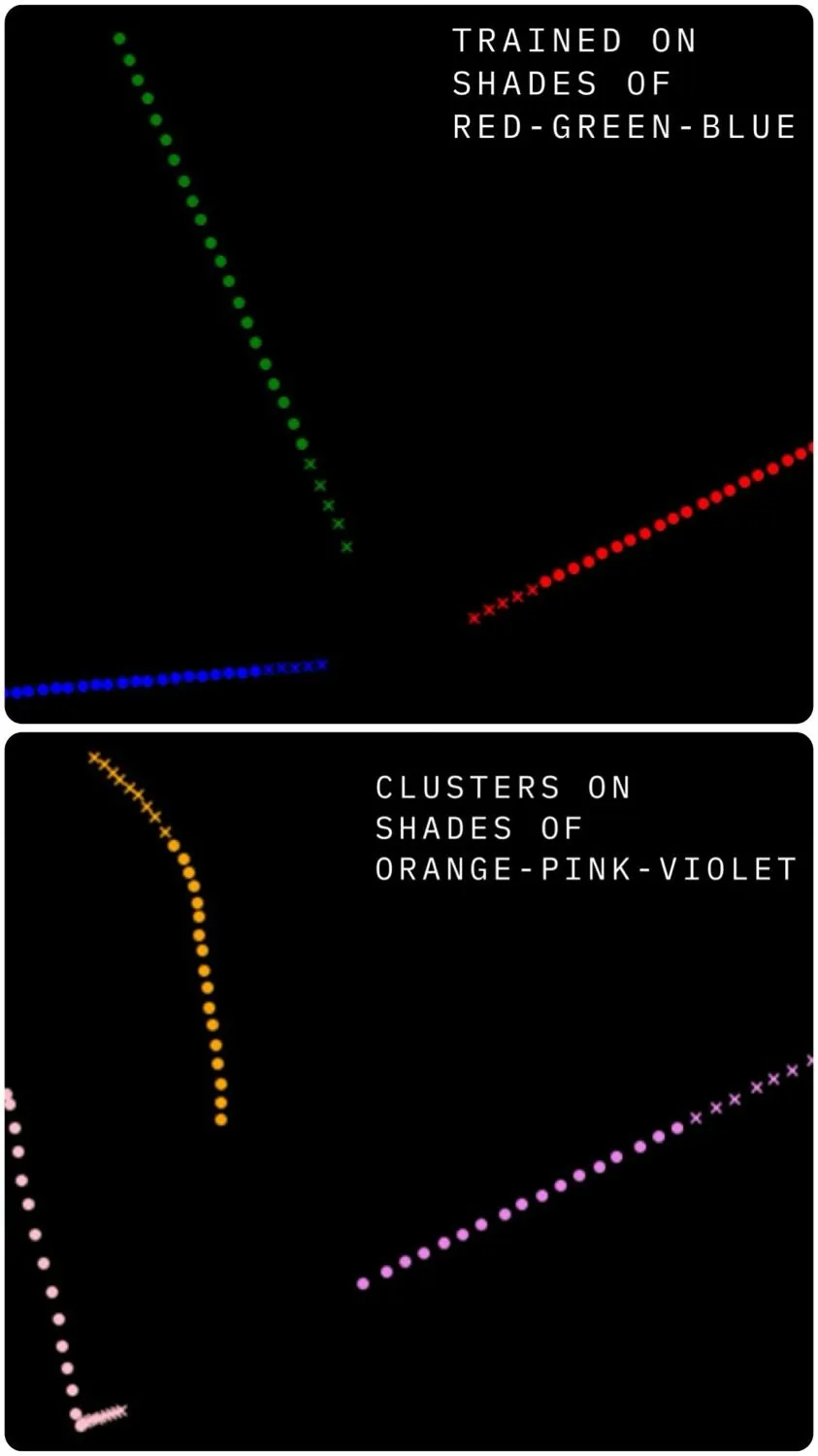
The remarkable finding came during the testing phase, when entirely new and unseen color classes, specifically shades of orange, pink, and violet, were introduced to the model. Rather than producing random or chaotic outputs, the classifier demonstrated a surprisingly structured response, grouping these unseen color shades into distinct and coherent clusters within its learned embedding space.
This emergent clustering behavior, observed visually to resemble the organized formation of Starlink satellites, suggests that the model had internalized a deeper understanding of color relationships and visual similarity that transcended its explicit training objective.
While it is important to acknowledge that this behavior does not match the precision or robustness of dedicated few-shot learning techniques such as triplet loss training or contrastive learning, which are explicitly designed and optimized for such generalization tasks, the classifier's performance in this context is still noteworthy and opens up interesting questions about the latent representational power hidden within conventional classification architectures.
The simplicity of the dataset, involving visually coherent and perceptually meaningful categories like color shades, likely played a significant role in enabling this behavior, and it remains to be seen how well such emergent clustering would hold up on more complex or abstract image categories.
Nevertheless, this research serves as a compelling reminder that the boundary between classification and few-shot learning is not always as rigid as it may seem, and that standard classifiers may possess untapped potential for generalization that has yet to be fully explored or leveraged.
Comments